Korean Phonology for the KAEPS system
|
At present, the following are considered in the KAEPS system.
1. Vowel System
(1) |
Figure 1. (Simple) Vowel Chart of Korean

|
Figure 1 expresses only the simple vowels of modern standard Korean. Korean
has two pairs of non-low back vowels: high and mid rounded vowels, /u, o/,
and high and mid unrounded vowels, / ,
,
 /. The unrounded back vowels are
more forward than their corresponding rounded ones. The distance between two
non-high front vowels, /e/ and /
/. The unrounded back vowels are
more forward than their corresponding rounded ones. The distance between two
non-high front vowels, /e/ and / /, is so close
that many Koreans may not distinguish them from each other. All Korean vowels
are tense vowels, so that there is no tense-lax distinction such as /i/
vs. /
/, is so close
that many Koreans may not distinguish them from each other. All Korean vowels
are tense vowels, so that there is no tense-lax distinction such as /i/
vs. / / and /u/ vs. /
 / as in English.
2. Consonant System
| (1) |
Figure 2. Consonant Chart of Korean

|
One characteristic of Korean consonants, shown in Figure 2, is that there
are three distinctive voiceless sounds in the stop and affricate categories
(H-B Park, 1992; Kenstowicz, 1994; M-R Kim, 1994; Nam & Southard, 1994; HS
Kim & Jongman, 1996). These are (1) (strongly) aspirated sounds
/p , t,
k,
, t,
k,
 /;
(2) unaspirated fortis sounds /p*, t*, k*,
*/; and (3) unaspirated
(or slightly aspirated) lenis sounds /p, t, k,
/. In
Korean, the number of fricatives is very small compared to that of stops.
There are one glottal fricative /h/ and two alveolar fricatives, of which
one is a fortis /s*/ and the other a lenis /s/. There are no fricatives
such as /f, v,
/;
(2) unaspirated fortis sounds /p*, t*, k*,
*/; and (3) unaspirated
(or slightly aspirated) lenis sounds /p, t, k,
/. In
Korean, the number of fricatives is very small compared to that of stops.
There are one glottal fricative /h/ and two alveolar fricatives, of which
one is a fortis /s*/ and the other a lenis /s/. There are no fricatives
such as /f, v,  ,
,  , z,
, z,  ,
,
 /. There are three nasals, /m, n,
 /. There is only one glide
 '[ril]'
in Korea, which is complementarily distributed between /r/ and /l/.
'[ril]'
in Korea, which is complementarily distributed between /r/ and /l/.
3. Syllable-Final
Neutralization
All the Korean consonants are distinctive only in the syllable
onset position, except // which
appears only in the syllable coda position. However, just seven
consonants, [p, t, k, l, m, n, ], can appear in the syllable coda position. The stop sounds are
neutralized as a homorganic lenis stop, and affricates and fricatives as a
coronal lenis stop [t] (H-S Kim, 1990; D-S Park, 1990; J-S Kim, 1992;
J-S Lee, 1992;
H-B Park, 1992; Nam & Southard, 1994; HS Kim & Jongman, 1996). The rule can
be formulated as follows:
| (3) |
Syllable Final Neutralization Rule (SFNR)
 |
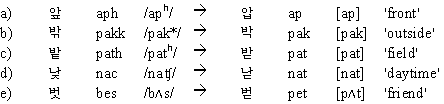
The examples under the application of this rule are given in (4):
| (4) |
 |
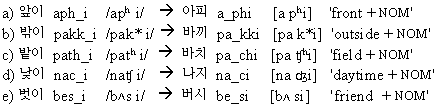
However, if a particle starting with a vowel is attached to the words in (4),
resyllabification occurs and the consonants in the coda position are moved
to the onset position of the following syllable before the application of
SFNR (3). Let me show some examples, adding a nominative particle "-i" to
each word of (4) above.
| (5) |
 |
4. Lenis Stop Voicing
Example (5-d) shows us that there is another phonological rule
in Korean. Korean lenis stop and affricate sounds such as /p, t, k,
/
change into corresponding voiced sounds between two voiced sounds according
to the Lenis Stop Voicing Rule (Paik, 1977; H-B Lee, 1982; D-S Park, 1990;
J-S Kim, 1992; J-S Lee, 1992; Nam & Southard, 1994; Jun, 1995). Thus, voiced
obstruents such as [b, d, g,  ] exist
in Korean as allophones, even though
they are not phonemes. However, the /s/ sound does not change into /z/
between two voiced sounds as shown in (5-e) above. The formulation of
this rule and some examples are given below:
] exist
in Korean as allophones, even though
they are not phonemes. However, the /s/ sound does not change into /z/
between two voiced sounds as shown in (5-e) above. The formulation of
this rule and some examples are given below:
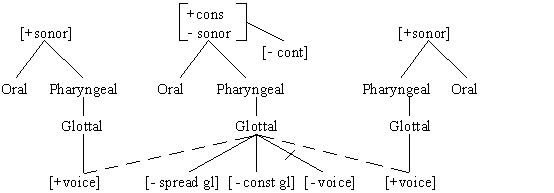
| (6) |
Lenis Stop Voicing Rule (LSVR)
 |
This rule can apply not only within a word but also across a word boundary,
as shown below:
| (7) |
 |
This rule does not seem to apply to a compound, nath_al /na #al/ 'each + grain,' since the target consonant is
not a lenis stop. However, the rule applies to the word after the
application of SFNR (3), preventing it from being pronounced as na_thal
/na al/ by resyllabification. The
following shows the process of its derivation:
#al/ 'each + grain,' since the target consonant is
not a lenis stop. However, the rule applies to the word after the
application of SFNR (3), preventing it from being pronounced as na_thal
/na al/ by resyllabification. The
following shows the process of its derivation:
| (8) |
 |
5. Nasalization
An obstruent preceding a nasal is switched into
its homorganic nasal sound. This nasalization is not a secondary
articulation, but a complete consonant assimilation (Paik, 1977; D-S Park,
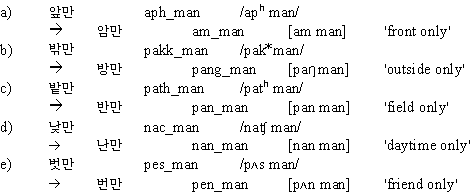
1990; Choi, 1991; J-S Kim, 1992; J-S Lee, 1992; Kang, 1992). The following
are the examples of (4) above, to which a Korean suffix man 'only'
is attached.
| (9) |
 |
According to the above examples, the nasalization rule may be roughly
formulated as follows:
(10) C --> [+nasal] / V ___] [+nasal]
However, this rule seems too broad to be explainable. In the case of
(9-c,d,e) for example, different voiceless consonants with different
features (i.e., an aspirated alveolar stop /t/,
an alveolar fricative /s/, and a palato-alveolar affricate
//) become a (voiced) alveolar nasal /n/.
Notice that the target obstruent for the application of
the nasalization rule is under the environments for both the SFNR (3) and
the LSVR (5). After the application of these rules, the target obstruent
is a voiced lenis stop, and the formulation of this rule can be drawn as
follows:
| (11) |
Nasalization Rule (NasR)
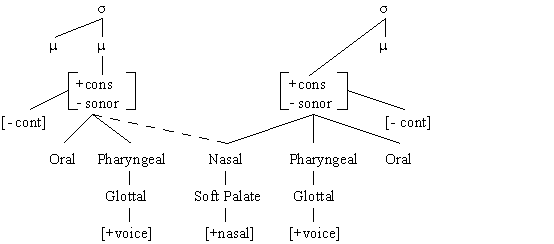 |
Accordingly, the derivation of pes_man /ps
man/ 'friend only' in (9-e) is as follows:
| (12) |
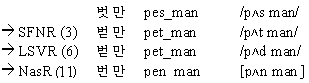 |
6. /n/-Insertion
In a compound or a derived word, if the last sound of the previous
word or prefix is a consonant followed by a /i/ or /j/ of the next
word, /n/ is inserted between the two words. The rule can be formulated
as follows:
| (13) |
/n/ Insertion Rule (n-IR)
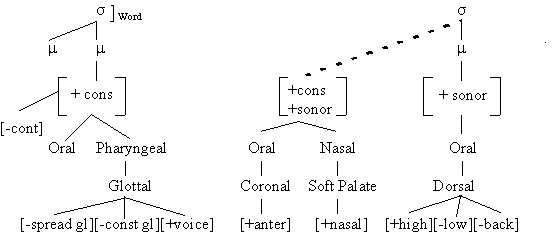 |
The examples are given in (14). This rule applies before the NasR(11) and
provide the environments for the NasR as shown in (14-d).
| (14) |
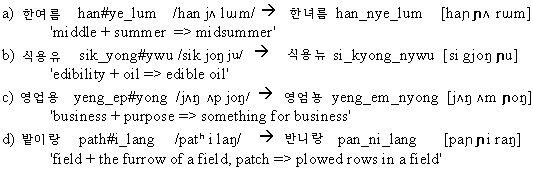 |
[last updated June 25, 1999]
Hyouk-Keun Kim